A’s postcards
Cartes Postales from GreeceA’s postcards are anonymous messages from Greece that become much more than misdirected mail: for Ellie Thomas, their vivid images and incomplete stories make an elsewhere imaginable, then help prompt her to go there herself. Their worn, fragmentary form carries both the romance of distance and the limits of a view assembled from postcards.
Physical form and circulation
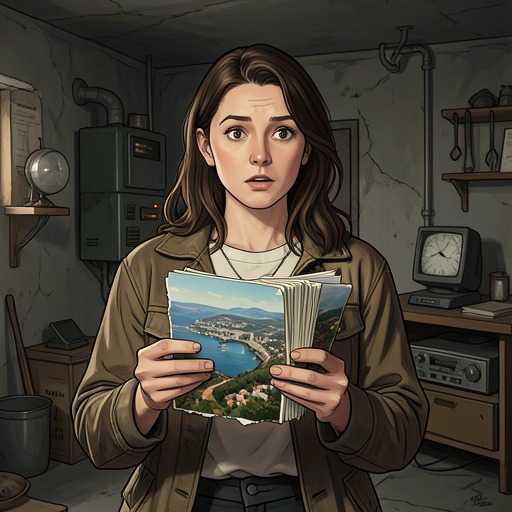
The cards arrive dog-eared and torn, sometimes almost illegible, as if they have crossed Europe in a back pocket. Their ink appears washed by rain, wine, or tears; sunshine has bleached some, and faded postmarks suggest journeys lasting many weeks. The damage makes their travels tangible, while the writing and images preserve what has survived them.
The first card appears at the end of December, and thereafter the arrivals become increasingly regular. Ellie initially assumes they are intended for S. Ibbotson, perhaps a former tenant, and returns stray mail to the postbox with a note for the sender. These cards cannot be returned: the writer’s address is unknown, and each is signed only with an A. In the three years Ellie has lived in the flat, nothing else has arrived for S. Ibbotson. Rather than discard the cards, she gives them a place on a corkboard that otherwise serves for an occasional shopping list and a scrap bearing her National Insurance number.
An unfolding map of Greece
Pinned together, the cards form a mosaic dominated by blue and white: skies, sea, boats, whitewashed buildings, blue shutters, and, on some cards, the Greek flag. Their locations accumulate across the board. Names including Methoni, Mystras, Monemvasia, Nafpaktos, Nafplio, Olympia, and Sparta seem to Ellie to carry a spell of their own. The images brighten the basement flat more effectively than its Habitat throws have managed.
The writer’s script is neat and slightly artistic, though occasionally hard to read, and the messages offer little practical information. Instead, they convey enthusiasm: Nafplio has something special about it; Kalamata has a warm atmosphere. In April, three cards arrive at once, prompting Ellie to find her old atlas, tear out a page, and pin it beside the collection. She marks Arta, Preveza, and Meteora, turning the corkboard into a record of the writer’s route as well as a display of images.
Stories, intimacy, and idealization
The cards offer Ellie glimpses not only of places but of a social life she has never imagined. In one account, the writer describes being approached by strangers who ask where the visitor comes from and what they are doing there. The message depicts people inviting a stranger to their homes, to panegyris, and even to baptisms; at cafés, they offer a place at the table and stories to hear. The writer says those stories are written down, while acknowledging that memory can soften the edges of truth. The postcards thus present their account of Greece as personal and hospitable, but not as an unmediated record.
Their appeal lies partly in what they leave unsaid. The writer says photographs cannot convey the scents or sounds of Greece: each image is only a snapshot, a glimpse. The cards supply neither a complete itinerary nor a full account of the people encountered. Instead, their fragments invite Ellie to imagine the missing experience. She begins imagining herself as S, the absent addressee, and dreams of the places that A seems to be calling S toward. The closing sentiment that a place is nothing without its absent companion makes the correspondence intimate and sorrowful, though the intended reader remains unknown to Ellie.
Ellie’s response and the silence
Week by week, the cards make Greece part of Ellie’s life before she has visited it. Through winter, she leaves for work before dawn and returns at seven, with the curtains of her London flat remaining closed even after spring comes. The postcards’ sunshine and luminous colours become a counter-image to that routine. At work, she sells advertising space in a trade magazine; while she meets her targets, she spends spare time looking online at Greek places. Her colleagues dream of being on stage; her own longing is to be somewhere far beyond the West End.
With summer come images of Andros and Ikaria, their blue seas and skies so beautiful that Ellie wonders whether the places are real or the pictures have been airbrushed. Then the arrivals stop. Throughout August she checks her pigeonhole each morning, and every empty search disappoints her. After returning from Cardiff, she finds no card and calculates that more than a month has passed since the one from Ikaria. Back at the flat, she notices that the cards have begun to curl on the board, though their colours remain vivid. Their increasingly visible physical age sharpens the question of whether their blue skies and translucent light correspond to anything beyond the image.
Ellie checks a passport last used for a trip to Spain two years earlier and finds a cheap flight to Athens. She is not an adventurous traveller: her previous trips have been to Spain, Portugal, and France. She chooses a week’s half-board at a beach resort near Nafplio, a place she recognizes from A’s route, and makes the decision spontaneously, though it feels to her as if the idea has been planted over months. The gap in the correspondence does not resolve the identity of A or S; instead, the cards’ most consequential effect is to move Ellie from imagined participation toward travel of her own.
The postcard image and the encountered place
The book’s later travel account complicates the postcard’s promise of a uniformly welcoming Greece. Near Lamia, a traveler reaches a beautiful fishing village through meadows and crops, past abundant oranges and lemons, to a sheltered harbour, colourful boats, a sandy cove, and olive trees on the hillsides. Yet the locals show little interest in visitors: restaurant customers are dismissive, and the village has no tourist accommodation or even a shop selling postcards, sun lotion, or straw hats. The traveler calls it a place lacking Filoxenia as a measure of welcome.
That encounter makes the postcard’s selectivity matter. A view can be beautiful without guaranteeing hospitality, and the character of a place may depend on the greeting a visitor receives as much as on its scenery. Against the cards’ bright, portable Greece, the village offers a specific and uncomfortable counterexample. The postcards remain invitations, but the journey they inspire must test their idealized glimpses against places and encounters that cannot be pinned neatly to a board.